
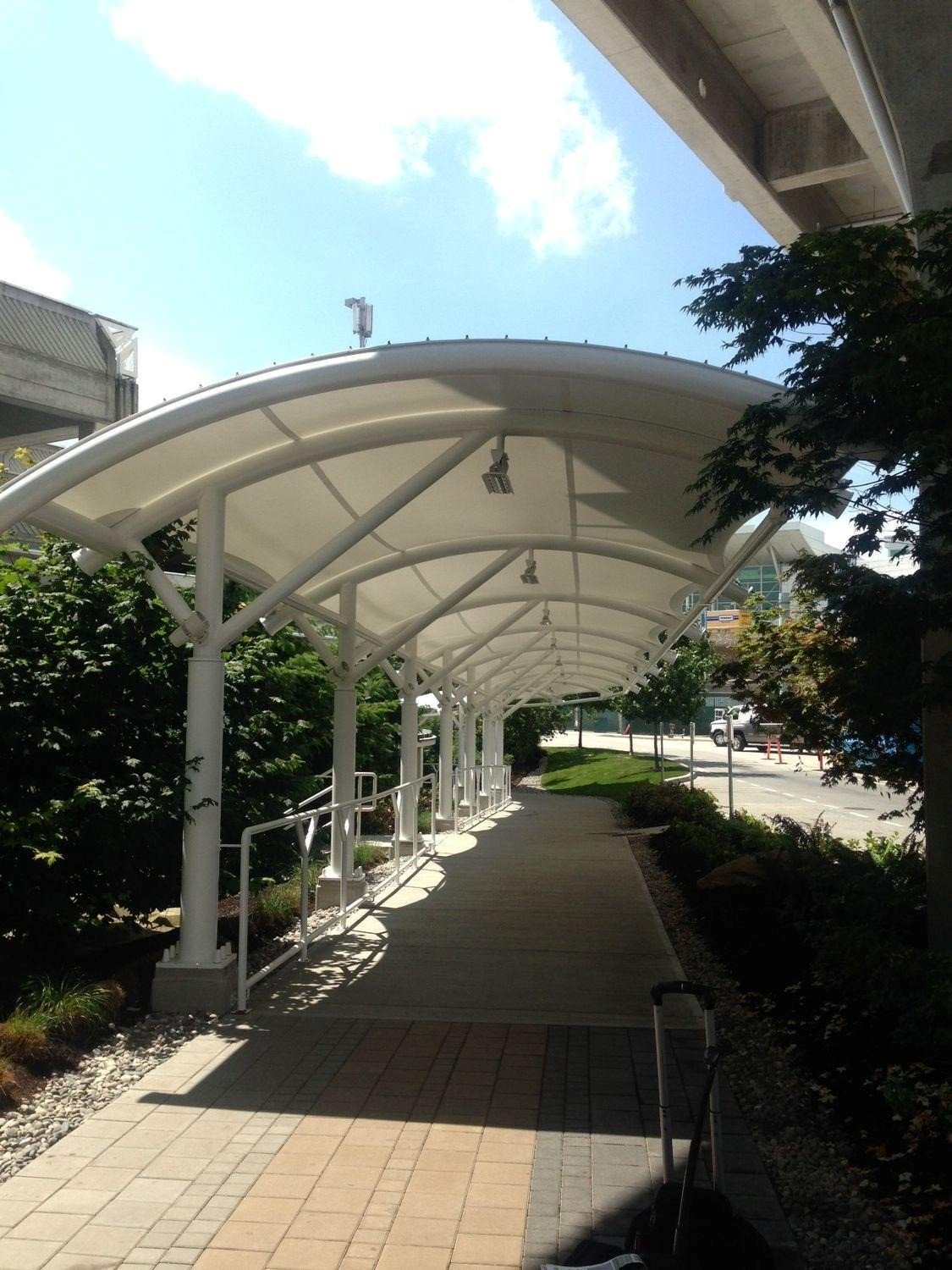
Structural Safety Offers No Margin for Guesswork or Cost-Cutting
In architectural canopies and structural steel projects, the financial cost of correcting a structural defect post-installation exponentially exceeds executing it correctly from day one. Structural failures not only decimate capital investment, but pose severe liability risks to vehicles, property, and human safety.
Sectors Where Structural Failure Carries Catastrophic Consequences:
Defect prevention is mandatory across high-traffic, mission-critical assets:
- ▪Airports & Mass Transit Terminals subject to intensified atmospheric wind turbulence
- ▪Logistics Hubs & Freight Warehouses subject to heavy machinery vibrations
- ▪Educational Campuses & Universities safeguarding thousands of students and vehicles daily
- ▪Commercial Centers & Towers governed by strict Civil Defense safety audits
- ▪Coastal Industrial Zones exposed to hyper-corrosive saline humidity
- ▪Sports Stadiums & Long-Span Public Facilities requiring zero-tolerance structural integrity
The Six Primary Structural Errors Destroying Canopy Projects
Among the ten major project pitfalls, these six structural errors account for over 85% of premature failures across the region:
Selecting the Lowest Bid Without Auditing Specifications
A bid dramatically below market rate inevitably conceals undersized steel walls, unbranded fabrics without UV stabilizers, and omitted hot-dip galvanizing.
Neglecting Certified Wind Load & Stress Analyses
Relying on arbitrary workshop guesswork instead of finite element structural analysis, causing catastrophic frame collapse during severe desert storms.
Specifying Thin, Inadequate Hollow Sections (SHS/CHS)
Installing 1.8 mm steel tubing instead of engineered 4.0 to 6.0 mm sections; columns suffer progressive plastic deformation under dead and wind loads.
Selecting Unprotected Membranes Prone to UV Degradation
Membranes lacking genuine PVDF topcoats experience molecular chain scission under Saudi solar radiation, resulting in tearing and brittleness within two years.
Relying on Surface Spray Paint Without Hot-Dip Galvanizing
Standard primer cracks under thermal expansion; atmospheric moisture infiltrates internal pipe cavities, corroding walls hollow from the inside out.
Inadequate Footings & Low-Grade Anchor Bolts
Fixing structures with light expansion screws into surface asphalt instead of cast-in-place reinforced concrete footings engineered against overturning moments.
07 | Defective & Uncertified Welding
Employing uninspected manual spot welds instead of continuous multi-pass welds verified by certified structural weld inspectors (CWI).
08 | Disregarding Stormwater Drainage & Slope
Inadequate membrane camber and slope creates massive water pockets weighing hundreds of kilograms, causing immediate fabric rupture and frame buckling.
09 | Unqualified Field Erection Crews
Improper alignment, over-torqued bolts, or forced structural connections introduce dangerous built-in residual stresses across the entire canopy.
10 | Zero Preventative Maintenance & Fake Warranties
Neglecting scheduled cable re-tensioning and partnering with fly-by-night contractors who vanish when the first structural defect manifests.
Structural Risk Diagnosis & RAACO Engineering Solutions
| Common Project Failure Mode | Direct Site Consequence | RAACO Certified Engineering Remedy |
|---|---|---|
| Neglecting Wind Dynamics | Torn membranes or twisted structural columns | FEA structural wind simulation for 130–150 km/h (SBC) |
| Undersized Steel Tubing | Permanent plastic bending under dead weight | Heavy structural SHS/CHS profiles (4.0 mm – 8.0 mm) |
| Paint Without Galvanizing | Severe rust perforating steel from within | Hot-Dip Galvanizing + Oven-Baked Architectural Powder Coat |
| Cheap Commercial PVC | Rapid brittleness, cracking, and fading in 2 yrs | German/Korean PVDF & PTFE Architectural Membranes |
| Shallow Asphalt Screws | Complete structure blow-over during storm gusts | Reinforced concrete pad footings + Chemical Anchor Bolts |
| Flat Water Ponding | Water pockets tearing fabric and bowing beams | Engineered parabolic curvature with concealed drainage channels |
The Danger of Residual Stress in Crude Welds
Welding is a metallurgical science, not just joining two metals. Crude, uncontrolled site welding induces severe residual thermal stresses that drastically lower steel fatigue limits under cyclic wind loads. In RAACO, all structural welds comply strictly with AWS D1.1 structural welding standards.
Safety Factors in the Saudi Building Code
The Saudi Building Code mandates exacting safety coefficients across dead, live, wind, and seismic loads. Adhering to these engineering parameters protects lives, secures high-value vehicular assets, and shields facility owners from expensive litigation.